Terms of Use:
The archive materials provided below are for educational, scholarly, and archival purposes only. They may be freely downloaded, copied, distributed, and shared, provided that:
No commercial use — These materials may not be sold, used for commercial purposes, or included in any product or service offered for sale.
No alteration — The content may not be modified, abridged, or presented out of context in any way that misrepresents Dr. Cherepanov's legacy or the intent of the original work.
Attribution — Proper attribution must be given to www.genadycherepanov.com as the original source.
Archival intent — These materials are intended for personal, educational, and research use, and for preservation of Dr. Cherepanov's memory.
Images and Photos
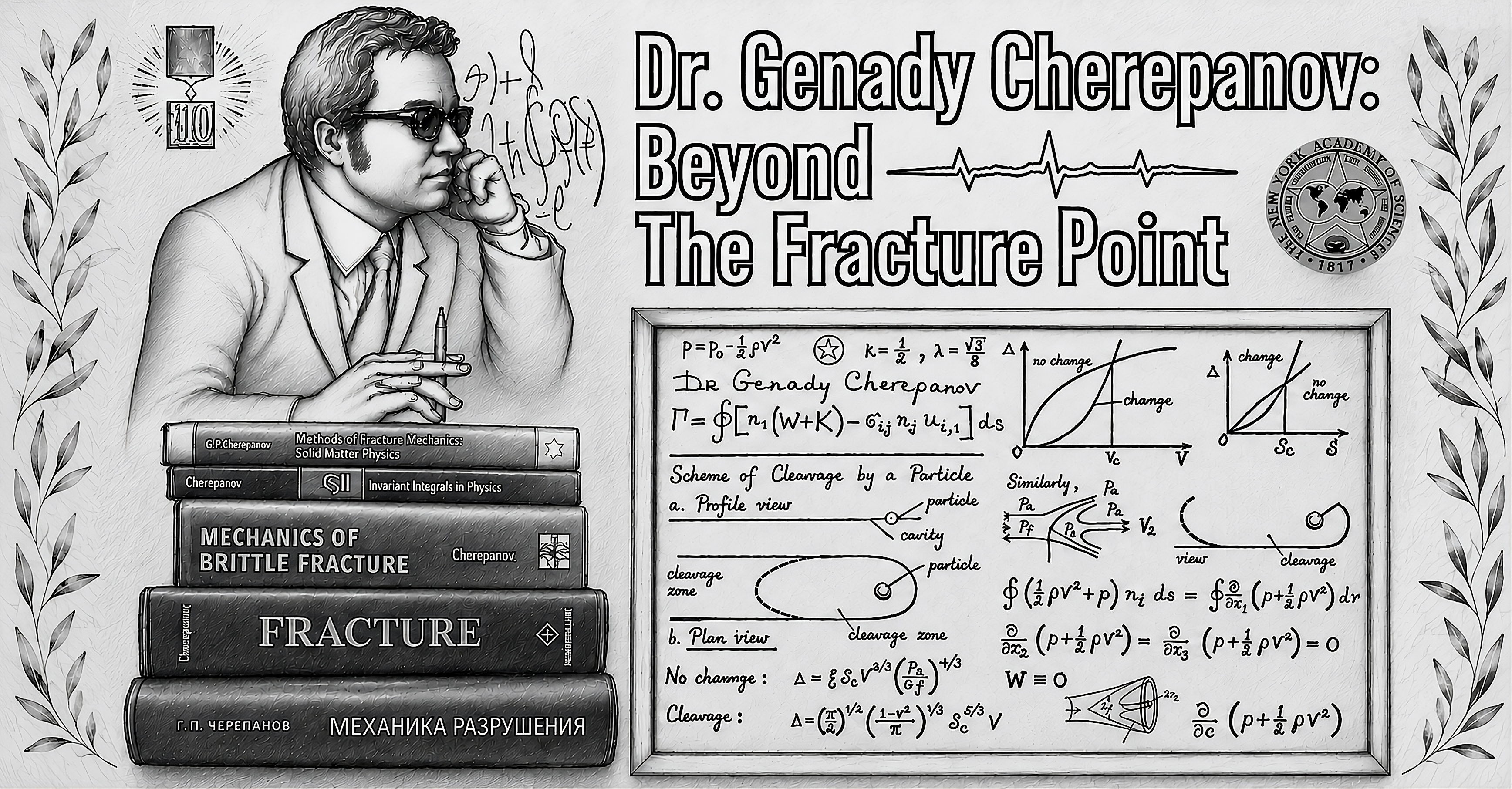
Dr. Genady P. Cherepanov memorial sketch 'Beyond The Fracture Point' — a tribute to his struggle for freedom of thought and unwavering commitment to the pursuit of truth, even when doing so was unpopular.
View and save image (48" x 25" poster) size: 7.11 MB
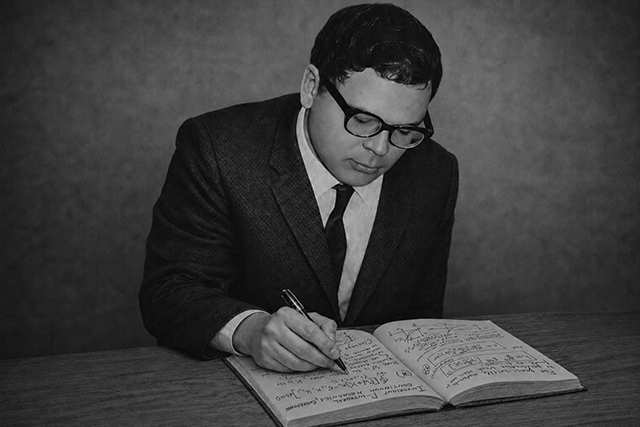
Artistic interpretation of Dr. Genady P. Cherepanov working on his monumental creation in Continuum Mechanics — 'Mechanics of Brittle Fracture' — at the end of the 1960s in Russia.
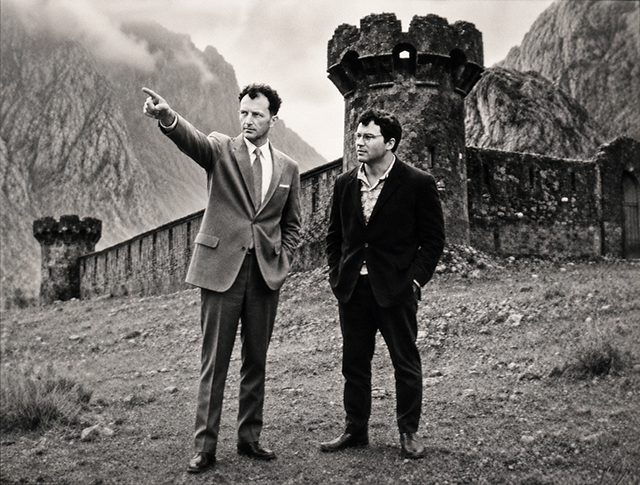
Artistic interpretation of Dr. Genady P. Cherepanov and Dr. Adolf Busemann (Operation Paperclip) standing in front of Queen Tamara Castle in the Republic of Georgia, circa 1963.
Historical context of the image is based on Dr. Cherepanov's published memoir 'SCIENTIFIC BATTLES: MOSCOW, 1960s' (in Russian). Below is a quote from that memoir translated to English:
"In the autumn of 1963, at an international scientific conference in Georgia, I accidentally met a thin, two-meter-tall von Busemann — the creator of the theory of conical flows in gas dynamics. Hitler's favorite, designer von Braun used his calculations when creating the world's first military strategic missiles V-1 and V-2, which bombarded London in 1943. Busemann was the chief theoretician in his team.
In 1945, the Americans kidnapped both of them and brought them to the USA, where they led the American rocket and space program.
I spoke German quite well then, and communicating with him tickled my nerves — I remembered the war and the fascist planes that sometimes machine-gunned our village.
I was struck that he knew the method of functionally-invariant solutions, related to his conical flows. Although this method was developed by Russian academicians V.I. Smirnov and S.L. Sobolev back in the 1930s, few people knew this method even in Russia.
I asked Busemann: 'Did you know Hitler?'
Busemann replied: 'Yes, of course. The Führer personally awarded me the Iron Cross with Oak Leaves and personally attached it to my uniform.'
I asked: 'What was he like, the Führer?'
Busemann calmly replied: 'A cultured and intelligent man.'
P.I. Perlin then photographed me with Busemann, standing at the castle of Queen Tamara. It is a pity that this photo, like many others, was lost in the haze of time: I have always been careless about history."
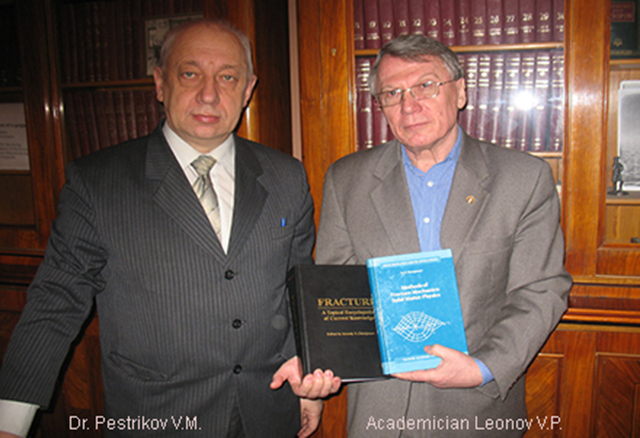
Dr. Genady Cherepanov donated his books to the Library of the Russian Academy of Sciences in 2009. Pestrikov — Doctor of Technical Sciences and Professor of Saint Petersburg University. Leonov — Academician of Ecology, Human Safety and Nature, Director of the Library.
Diploma, Awards, Honors, Newspaper Article
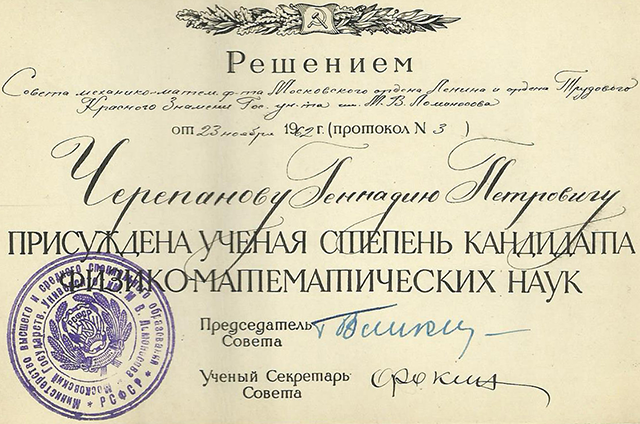
Genady Cherepanov's Master of Sciences
Diploma. In 1962, at the
age of 25, he defended his
Candidate of Sciences dissertation
at Moscow State University.
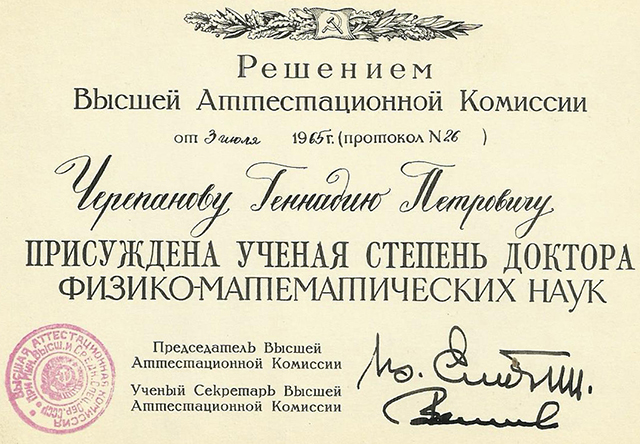
Dr. Genady Cherepanov's Doctor of Sciences
Diploma. In 1964, at the
age of 27, he defended his
Doctor of Sciences dissertation
at the Institute of Mechanics of
the Academy of Sciences of the USSR — making him
the youngest Doctor of Sciences
in Mathematics and Physics
in the entire USSR at that
time. Note: diploma was issued with a delay, only
next year!
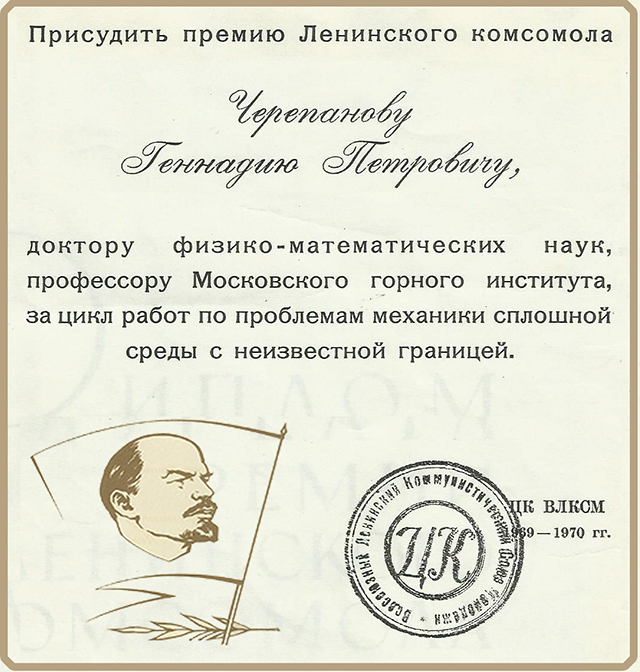
Dr. Genady Cherepanov's State Award: Lenin Komsomol Prize, 1970.
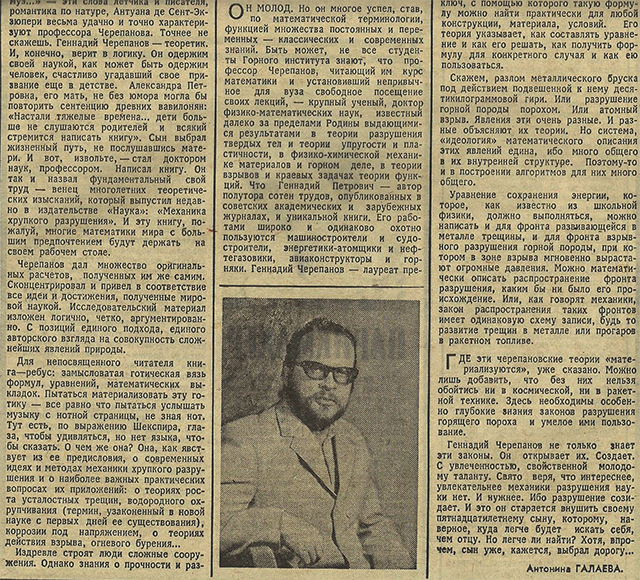
Article about Dr. Genady Cherepanov and his outstanding scientific achievements in the popular Soviet-era newspaper 'Week', written by correspondent Antonina Galaeva in 1975.
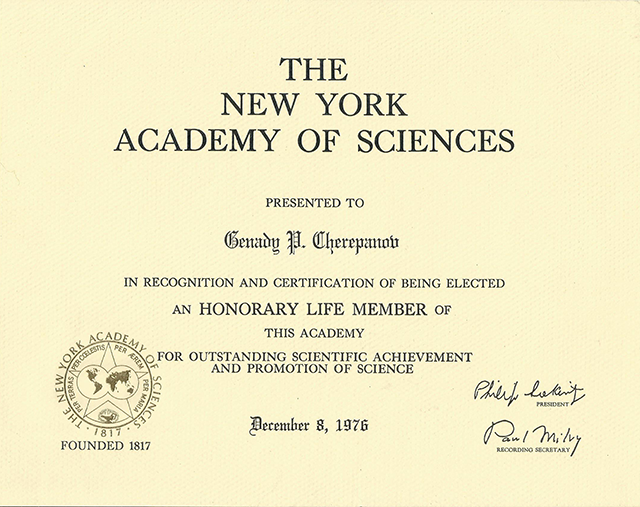
In 1976, Genady Cherepanov became the only scientist from the entire Soviet Union elected as an Honorary Life Member of the New York Academy of Sciences — one of the most prestigious academies in the world, which at that time had only about 100 members, almost all of whom were Nobel Prize winners. Dr. Cherepanov was elected alongside Linus Pauling and George Polya. The list of Honorary Life Members includes such outstanding scientists as C. Darwin, D. Mendeleev, J. Maxwell, J. Gibbs, A. Einstein, N. Bohr, W. Heisenberg, A. Sakharov, P. Kapitsa, L. Pauling, George Polya, and others.
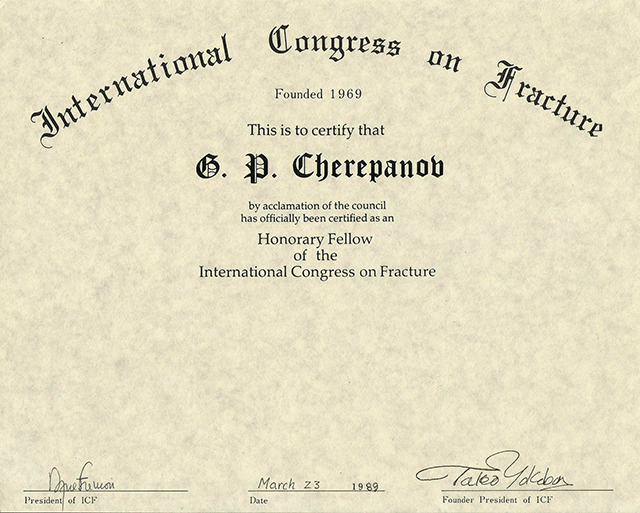
Certificate confirming that, in 1989, Genady P. Cherepanov
was officially elected an Honorary
Fellow of the International Congress on Fracture.
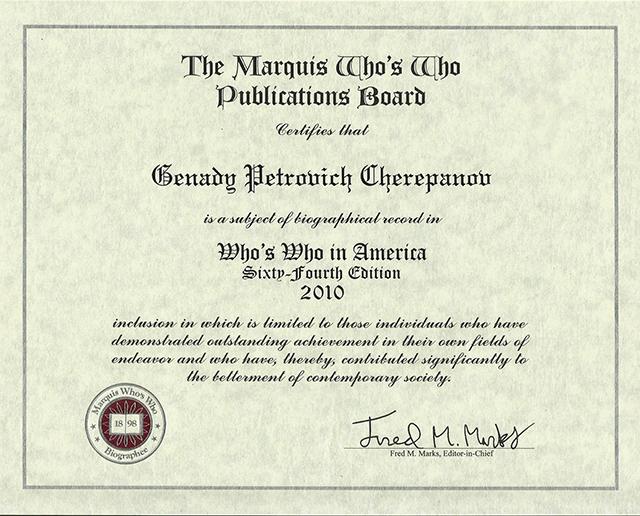
Dr. Cherepanov's biography has been elucidated in the following reference books:
* Marquis Who's Who in the World, 11th and other Editions
* Marquis Who's Who in America, 47th Edition
* Marquis Who's Who in Science and Engineering, 1st and other Editions
* Marquis Who's Who in the East, several Editions
* Marquis Who's Who in the South and Southwest, several Editions
* Men of Achievement, 16th Edition. International Biographical Center, Cambridge, U.K.
* Men and Women of Distinction. International Biographical Centre, Cambridge, U.K.
* International Man of the Year 1992/93. International Biographical Centre, Cambridge, U.K.
* American Men & Women of Science. A Reed Reference Publishing Co.
* The International Directory of Distinguished Leadership, Fifth Edition. American Biographical Institute
* Five Hundred Leaders of Influence. American Biographical Institute
* 2000 Outstanding Scientists of the 20th Century. International Biographical Centre, Cambridge, U.K. and other Editions.
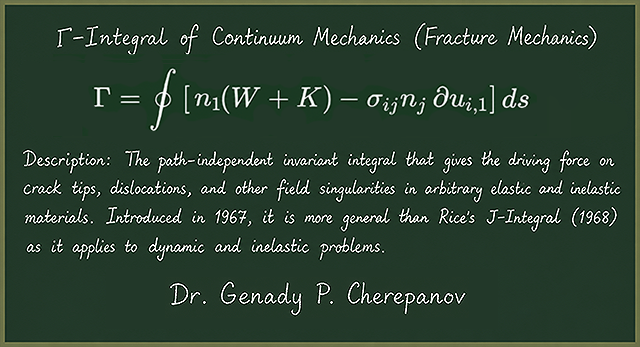
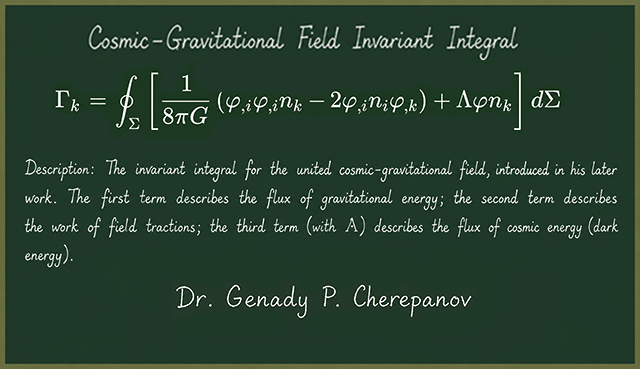
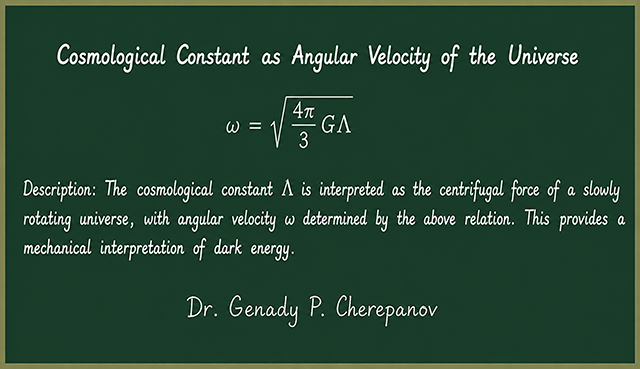
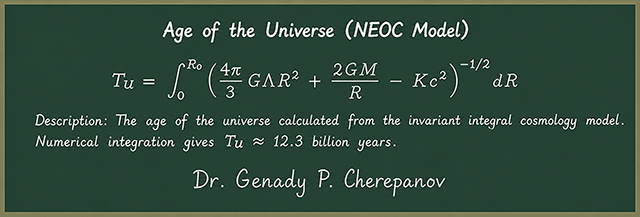
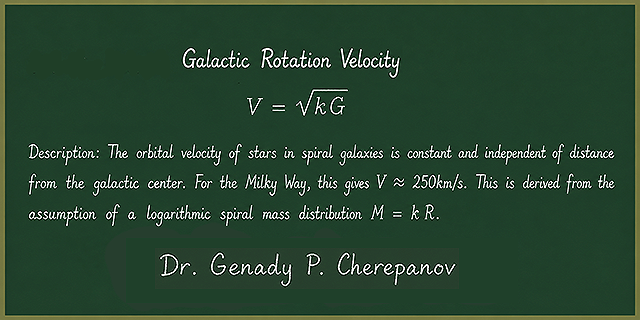
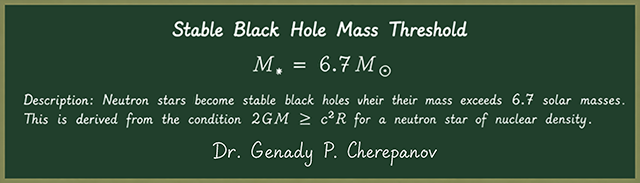
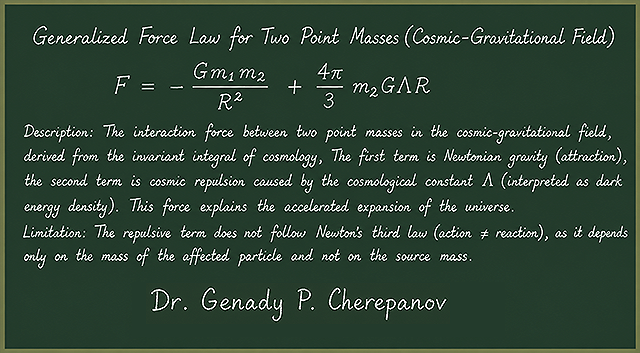
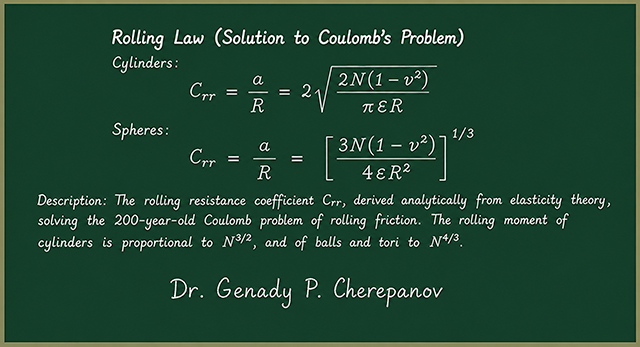
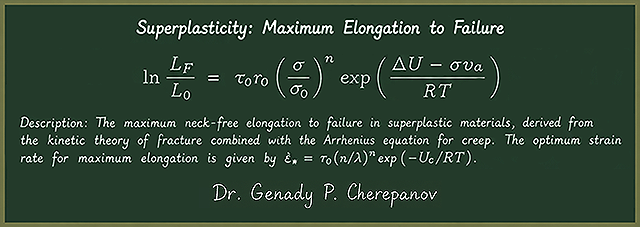
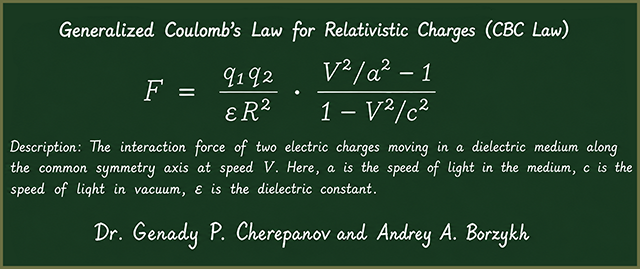
Some selected major discoveries made by Dr. Genady P. Cherepanov
The images with handwritten formulas are a non-commercial tribute to the scientific legacy of Dr. Genady P. Cherepanov. The mathematical formulas displayed are derived from his published work on invariant integrals, fracture mechanics, cosmology, and other fields. They are used for educational and critical purposes in accordance with fair use principles. All original discoveries remain the intellectual property of Dr. Cherepanov and his publishers.
The signature appearing at the bottom of each image is an artistic interpretation and acknowledgment of Dr. Cherepanov's work. It is not a reproduction of his actual handwritten signature and should not be used for any legal, commercial, or authorization purposes.
Dr. Genady P. Cherepanov — Poetry
The poems presented here are selected from Cherepanov's personal collection and are offered for educational, archival, and memorial purposes. They reveal a dimension of Dr. Cherepanov's character that science alone cannot capture — his sensitivity, his emotional honesty, and his search for meaning beyond the equations.
Poetry excerpted from:
Чер, Г. (2017). Поэзия Древнего Египта. Ridero. ISBN 978-5-4490-1079-7.
Licensed under a Creative Commons Attribution-ShareAlike 4.0 International License.
The author, Gena Cher, is the pseudonym of Dr. Genady P. Cherepanov.
Poems in English:
BLUE EYES*
Thy blue eyes
Softly look at me.
Elusive dreams rise
When I think of thee.
Thy blue eyes
Haunt me day and night.
Sea-blue dreams entice
My heart by their light.
*This song was selected to be an entry in the album "AMERICA", Hill Top Records, Beverly Hills, California (2009).
~~~~~~~~~~~~~~~~~~~~~~~
CARRION CROW: A RUSSIAN TUNE
(a defiant emotion)
Carrion crow, carrion crow,
Why are you flying so low,
You aren't getting a prey,
Carrion crow, go away!
You aren't getting a prey, (chorus)
Carrion crow, go away!
Tell my dear cherished love
That I've found a truelove
That is now my real wife
Who's, forever, the only life!
That is now my real wife (chorus)
Who's, forever, the only life!
Bullets wed me to the battle,
I became a gun's chattel,
And the sword is my wife
To wage war to the knife!
And the sword is my wife (chorus)
To wage war to the knife!
Carrion crow, carrion crow,
Why are you flying so low,
You aren't getting a prey,
Carrion crow, go away!
You aren't getting a prey, (chorus)
Carrion crow, go away!
Inspired by the Russian folk song "Черный ворон," this defiant poem reflects Dr. Cherepanov's resilience.
~~~~~~~~~~~~~~~~~~~~~~~
PLEASE SAY GOODBYE
(To S. Yesenin)
No pity, no call, and no tears.
All goes by and all is getting dim,
Golden gray sits down on my years,
The youth behind and life's becoming grim.
My heart is now beating not the way
It did in the past hid by the mist of time,
And the birch grove and the stack of hay
Don't allure me to walk in or climb.
The spirit of adventure stirs my blood
Not quite the way it did that long ago.
Where is the freshness of the bud,
The passion, and the senses for to glow?
My wishes are fading day by day.
Oh, my life! Or, was it just a dream?
It seems I have galloped all my way
On the pink steed in a sunny stream.
We are to pass away in the long run,
Stars go out, please say goodbye...
I bless everything that has been done,
All that has come to live and die.
A philosophical farewell to youth and life, inspired by the Russian poet Sergei Yesenin.
~~~~~~~~~~~~~~~~~~~~~~~
A LONELY SAIL
(To M. Lermontov)
A lonely sail shows white
In the milky mist of blue sea.
What is he looking for in that far site?
What has he left in homeland heart-free?
The wind roars, the waves play,
The mast bends almost to fall
But he looks for no luck at bay
And flees a happy fate, at all.
The azure stream runs in a fancy form,
The golden beam of light is like a balm
But the rebellion seeks for a storm,
As if the storm keeps calm!
A free interpretation of Lermontov's famous poem, reflecting the restless spirit of the Romantic rebel.
~~~~~~~~~~~~~~~~~~~~~~~
IN THE WILD NORTH
(To J. Goethe)
In the wild North, on a mountain peak,
A lonely pine stands wind-swung;
He sleeps and snow beak
Covers him with white curtains hung.
He dreams around the clock:
In that land the sunrise wherefrom
Single and sad, on the hot rock,
Grows a beautiful palm.
A translation and reinterpretation of Goethe's famous poem, capturing the longing for a distant, warmer world.
~~~~~~~~~~~~~~~~~~~~~~~
A DATE IN THE GRAVE
(To H. Heine)
She yearned for him, he longed for her,
With the highest passion, we must concur;
But they evaded dating and declaration
And suffered in silent mutilation.
Then they departed to proudly crave
Each other's love, in dream and prayer.
Death came. They got a date in the grave...
But, one could not see the other there.
A haunting meditation on love, loss, and the cruel irony of fate, inspired by Heinrich Heine.
Стихи на русском:
Стихи взяты из книги:
Чер, Г. (2017). Поэзия Древнего Египта. Ridero. ISBN 978-5-4490-1079-7.
Распространяется под лицензией Creative Commons Attribution-ShareAlike 4.0 International (CC BY-SA 4.0).
Автор, Гена Чер, является псевдонимом доктора Геннадия Петровича Черепанова.
ТЫ, ТИХИЙ ОКЕАН
Ты — Тихий океан, я — ручеёк,
Как мне понять тебя?
Я след оставил там, где тёк,
Не ведая того, что ты моя судьба.
Когда-то был я водопадом,
Крутая даль меня вела,
А моё счастье было рядом,
В омуте тихом, у села.
Но власти по-другому
Направили мой путь,
И к родному дому
Уж больше не свернуть.
Конец дороги близок,
Втеку я в океан,
А потом мой призрак
Смоет ураган.
О судьбе, о пути от малого к великому и о неизбежном слиянии с вечностью.
~~~~~~~~~~~~~~~~~~~~~~~
МЕЧТА
В сердце каждого созданья
Бьётся лёгкая мечта,
Для неё счастье — страданье,
Жизнь простая — тошнота.
От неё как птице в клетке
Никуда уйти нельзя,
Шаловлива та кокетка...
Но не смотрит мне в глаза.
Размышление о природе мечты — одновременно освобождающей и пленяющей.
~~~~~~~~~~~~~~~~~~~~~~~
ГРИБНОЙ ДОЖДЬ
Раз проснулся, слышу шорох,
Будто дождик на просторах,
Пальмы выстроились в ряд
И тихонько говорят:
"Друг наш ситный, оглянись-ка,
Вспомни жизни ураган,
Сколько было шума, риска,
И в кого стрелял наган.
Что ты ищешь в минном поле,
Накликать хочешь беду?
Мало ценишь свою долю,
Разум потерял в бреду?
Хочешь горные вершины
Взглядом снизу покорить,
Не боишься, что лавина
Может с головой накрыть?
Что с тобою, парень шалый?
Хоть по сердцу буря, град,
Где ты бед нажил немало,
Будь дождю грибному рад!
Уж не будет тебе счастья,
Позабудь о том навек,
Ничего кроме ненастья
Не несёт сверхчеловек.
В бурых пятнах гимнастёрка,
Что в крови твоего отца,
Той великой жизни тёрка
Бередит людей сердца."
Разговор с самим собой о жизни, риске, судьбе и памяти отца.
~~~~~~~~~~~~~~~~~~~~~~~
ЭДЕЛЬВЕЙС
Помню то утро,
Альпийский гнейс,
Будто из перламутра
Цветок эдельвейс.
Холод жестокий
В седой вышине,
Он — одинокий
В глухой тишине.
Судьбы злой рок
У него на роду,
Но грезит цветок
Про розу в саду!
Символ стойкости и одиночества — цветок в горах, мечтающий о садовой розе.
Все стихи представлены для образовательных и архивных целей.
Все права сохраняются за наследниками автора.
|